How to Clean Work Boots Properly
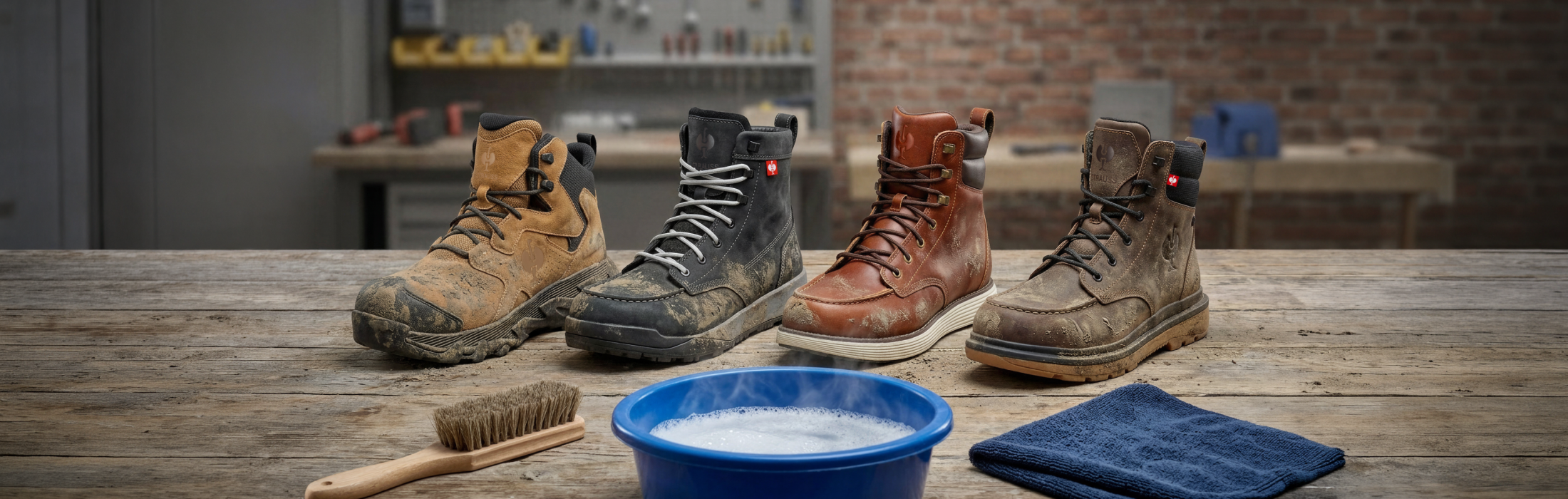
Strauss Editorial TeamYour work boots are your true safety companion. They protect you from impacts, sharp debris, wet ground, chemicals, and simply endless hours on the grind. But they can’t do this if they’re packed with mud, coated in concrete, or saturated with sweat from months without the right care. That’s why we’re here to help you keep your work boots clean and up to par, so you can remove the grime without causing any damage, ensuring your boots will last many years to come.
Why cleaning work boots matters
Boots fail far too often from reasons that are easy to combat. This could be salt drying out the materials, moisture breaking down glues and linings, and your daily grit acting like sandpaper. When you take action and clean your boots, here’s what you’re reducing:
● Leather cracking and stiffness (often caused by dirt and drying heat)
● Sole separation (water and chemicals weaken adhesives over time)
● Loss of traction (packed tread turns a slip-resistant sole into a smooth one)
● Odor and bacteria (sweat and damp insoles let bacteria and smells thrive)
● Waterproofing decline (DWR and membranes struggle when the outer fabric is clogged)
Maintenance is how you cash in on the quality of STRAUSS boots.
What you’ll need to clean your boots
You don’t need an entire kit to clean up your work boots. In fact, it just takes a few basics that you probably have lying around the house.
● Stiff brush (for soles/tread) and a softer brush (for uppers)
● Mild liquid soap or boot cleaner (ideally pH-neutral)
● Microfiber cloths or rags
● Warm (not hot) water
● Newspaper or boot dryer on low/no-heat setting
● Leather conditioner (for leather boots)
● Waterproofing spray/wax (if necessary)
● Optional: odor-control powder, replacement insoles, suede brush/eraser
Step-by-step: How to clean work boots
1) Remove laces and insoles
Take out the laces completely and pull the insoles. You need to do this because laces hold dirt and insoles trap moisture. If your insoles are soaked, set them aside to dry first. Your boots will dry much quicker with the footbed open.

2) Dry-brush before adding water
Brush off loose dirt while the boots are dry. Do this because wet dirt turns into a slurry that tends to works its way into seams and pores.
● Use the stiff brush on the outsole and tread.
● Use a softer brush for leather or textile uppers.
● Go outside and tap the soles together to knock out trapped debris.

3) Clean the outsole and tread
Packed tread kills your grip. Use warm water and a stiff brush. For heavy mud, a blunt tool (like a wooden stick) helps clear lugs without cutting the rubber.
If you’re dealing with oily residue, use a small amount of mild soap and rinse with a damp cloth—not a hard stream of water.

4) Clean the upper based on material
Leather uppers (full-grain or treated leather)
● Wipe with a damp cloth to remove surface dust.
● Mix a small amount of mild soap with warm water.
● Work in small sections, lightly scrubbing with a soft brush or cloth.
● Wipe off soap residue with a clean damp cloth.
Avoid soaking leather. Too much water strips oils and makes it stiff.
Synthetic or textile uppers
Synthetics handle water better, but adhesives and stitched seams still hate soaking.
● Use warm soapy water and a soft brush.
● Focus on flex points and stitching lines where grit collects.
● Wipe clean with a damp cloth.
Suede or nubuck
For suede/nubuck, water can stain and flatten the nap.
● Use a suede brush to lift dirt.
● Use a suede eraser for scuffs.
● If they get wet, let them dry naturally, then brush to restore texture.

5) Clean the inside
If your feet get sweaty, wipe the interior with a barely damp cloth and let them air out fully. For stubborn odour:
● Sprinkle a small amount of baking soda or boot deodorizer overnight.
● Replace your insoles if they’re permanently compressed or smelly.

6) Drying boots the right way
Let boots dry at room temperature with airflow.
● Stuff your booths with newspaper and let them dry upside down—replace the newspaper if it gets too damp.
● Keep boots away from radiators, heaters, or direct sun.
● If using a boot dryer, use no heat or low heat only.
High heat causes leather to crack and can soften glues.

Conditioning and protection
Leather conditioner
Once leather boots are fully dry, apply a boot conditioner. This restores oils and flexibility, reducing cracking at flex points like toe box and ankle. Use only a small amount, rub in evenly, and let it absorb.
Waterproofing
If your boots are marketed as waterproof or water-resistant, the outer layer still benefits from protection:
● Use a spray for textile/synthetic uppers.
● Use wax or cream for certain leathers (check compatibility as some waxes reduce the overall breathability.
A good rule of thumb: waterproof after deep cleaning or when water stops beading on the surface.
What to avoid when cleaning work boots
These are the common boot killers:
● Machine washing (agitation and soaking can destroy its structure and adhesives)
● Dish soap/degreasers/solvents (these are too harsh, strips oils, and damages finishes)
● Bleach (it weakens the materials and stitching)
● Heat drying (it causes cracking, shrinkage, glue failure)
● Leaving boots dirty for weeks (grit and salt do long-term damage)
Pro habits that extend boot life
● Clean little, but often: a quick weekly brushing beats a “rescue clean” every few months.
● Rotate pairs, which gives the boots 24 hours to dry, reducing odor and liner breakdown.
● Replace insoles and laces
Inspect seams and soles, as catching a small separation early can mean a simple repair instead of replacement.
When to repair vs. replace
Repair is usually worth it when:
● The upper is intact but the sole is worn (you can usually resole the boots)
● Stitching needs reinforcement
● Eyelets, hooks, or laces fail
Replace boots when:
● Tread is gone and traction is unsafe
● The boot no longer supports your foot (issues like a collapsed heel counter or broken shank)
● Waterproof lining is torn and can’t be restored
● Cracks run deep through leather at flex points